
Steeplemark Church Health Assessment
Clarity for a Healthier Tomorrow
Every church has a story being told through its people, patterns, leadership, and community. The Steeplemark Church Health Assessment brings those pieces together to help leaders understand where their church is today and what deserves attention next.
What is the Assessment?
The Steeplemark Church Health Assessment is a structured process for helping churches understand what is happening beneath the surface. It brings together congregational feedback, leadership perspective, ministry patterns, and church context so leaders can see where the church is healthy, where concerns are emerging, and what deserves attention next.
It is not designed to rank your church, produce a generic score, or tell leaders what they already know. The purpose is to identify patterns, surface differences in perception, and give your leadership team a clearer basis for discussion and decision-making.
We are looking for healthy processes, not perfect people.
Your Questions, Answered
-
The assessment looks at the life of the church from several angles, including congregational experience, leadership and decision-making processes, ministry patterns, communication, discipleship, change readiness, participation, mission, and the church’s relationship with its community. The goal is to identify patterns across these areas rather than judge the church based on a single score or statistic.
-
After purchase, your church receives access to the Steeplemark assessment process and a private survey link to share with participants. Your church selects a survey window and distributes the link to members and leaders.
Once the survey closes, Steeplemark reviews the responses, looks for patterns across scaled and open-ended questions, compares perspectives between groups where useful, and identifies strengths, concerns, opportunities, cautions, and areas that deserve closer attention.
Steeplemark then prepares a customized Church Health Assessment report that summarizes the findings and provides recommended next steps for leadership. The final report is delivered to the church for review and discussion.
-
The congregational survey is designed for people who are actively connected to the church and understand its life and ministry. Leadership questions also allow us to compare how pastors, board members, lay leaders, and the broader congregation may experience the church differently.
-
The survey is designed to be completed in one sitting. Completion time will vary because the assessment includes both scaled questions and open-ended questions that give participants room to explain what they are seeing and experiencing.
-
Yes. The purpose of the assessment is to identify patterns across the congregation, not to evaluate individual respondents. Findings are presented in a way that focuses on themes, trends, and differences in perception rather than identifying specific people.
-
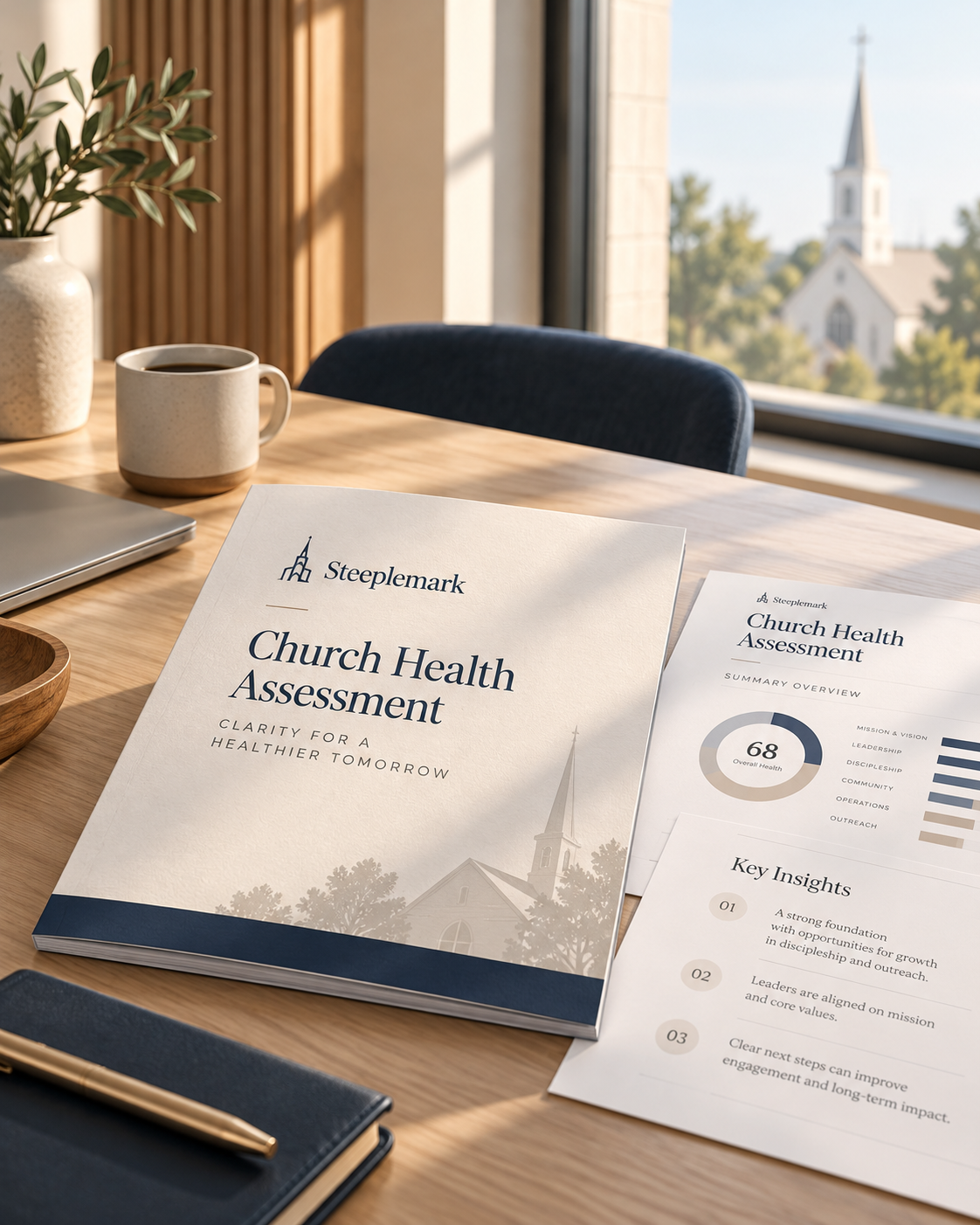
Your church receives a customized Steeplemark report that includes an executive summary, key findings, strengths and concerns, opportunities and cautions, and recommended next steps. The report is designed to help leaders understand what the responses are saying and decide where attention should go next.
-
Steeplemark may use scores and response patterns as analytical tools, but the purpose is not to label a church as healthy or unhealthy. A number by itself rarely tells the whole story. The assessment looks at how different pieces fit together and where those patterns point.
-
No. The assessment can be useful for healthy churches, plateaued churches, churches experiencing decline, churches preparing for change, or churches simply wanting a clearer understanding of where they are. It can also be helpful before strategic planning, pastoral transitions, revitalization efforts, or major ministry decisions.
-
IRating scales help us identify patterns, but they do not always explain why people answered the way they did. Open-ended questions allow participants to describe experiences, concerns, strengths, and opportunities in their own words. Those responses often provide important context for the numerical results.
-
Differences in perception are often some of the most useful findings in an assessment. Steeplemark looks for places where groups experience the same issue differently, such as differences between leadership and the congregation. Those gaps are presented as information for leaders to explore, not as evidence that one group is right and another is wrong.Item description
-
The report provides recommended priorities and next steps, but it is not intended to replace the judgment of local church leaders. Steeplemark helps leaders see the situation more clearly so they can make better decisions within their own church and ministry context.
-
Yes. Steeplemark can use the same assessment framework across multiple congregations while keeping each church’s responses, findings, and recommendations specific to that congregation. This gives networks a common framework without treating every church as though it has the same needs.
-
Yes. Additional consultation can be arranged when a church or network wants help interpreting the findings, discussing priorities, or planning what to do next. The assessment itself is designed to stand on its own, so additional consulting is optional. For information about additional consulting contact Josh@steeplemark.com
-
Steeplemark is looking for healthy patterns and healthy processes. Churches are made up of imperfect people, so the goal is not to find a perfect congregation. The goal is to understand how the church functions, how people experience its ministry, and where better processes may help the church move forward.
-
Once the survey period closes, most churches can expect to receive their completed Steeplemark Church Health Assessment report within 7–10 business days. The exact timing may vary depending on the number of responses and the amount of open-ended feedback that needs to be reviewed.
-
The base Steeplemark Church Health Assessment includes access to the congregational assessment, analysis of the responses, identification of key patterns and themes, and a customized final report with findings and recommended next steps.